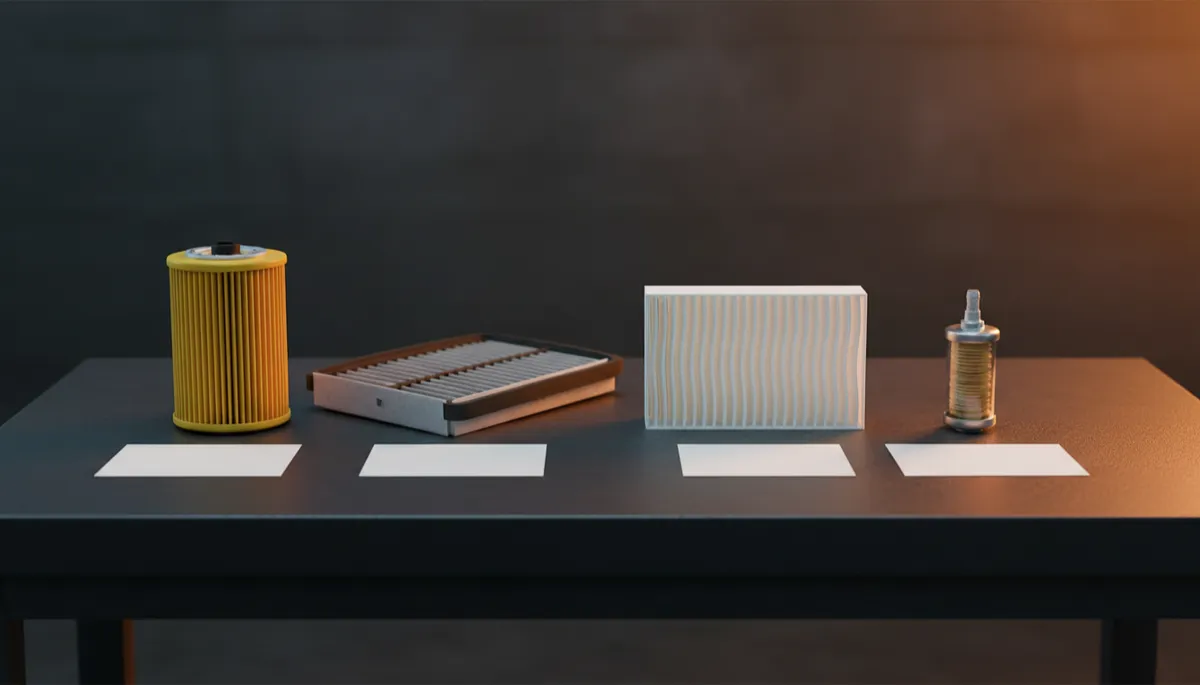
Essential Car Filters: Oil, Air, Cabin & Fuel Explained
Automotive Parts, Car Filters Explained
Which Filters Does Your Car Need? Oil, Air, Cabin and Fuel Filters Explained
You book a service and the workshop phones: “Your car needs new filters.” Maybe you are trying to order parts before you go in. You ask, “Which ones? All of them?” The honest answer is that it depends on your vehicle and its service schedule. Cars use different filters for different jobs, often on different cycles. Not every car has every filter as a separate replaceable part. Ordering a “full filter set” without checking can mean buying spares you do not need and missing ones you do. Here is what each filter does and how to find what your car actually needs.
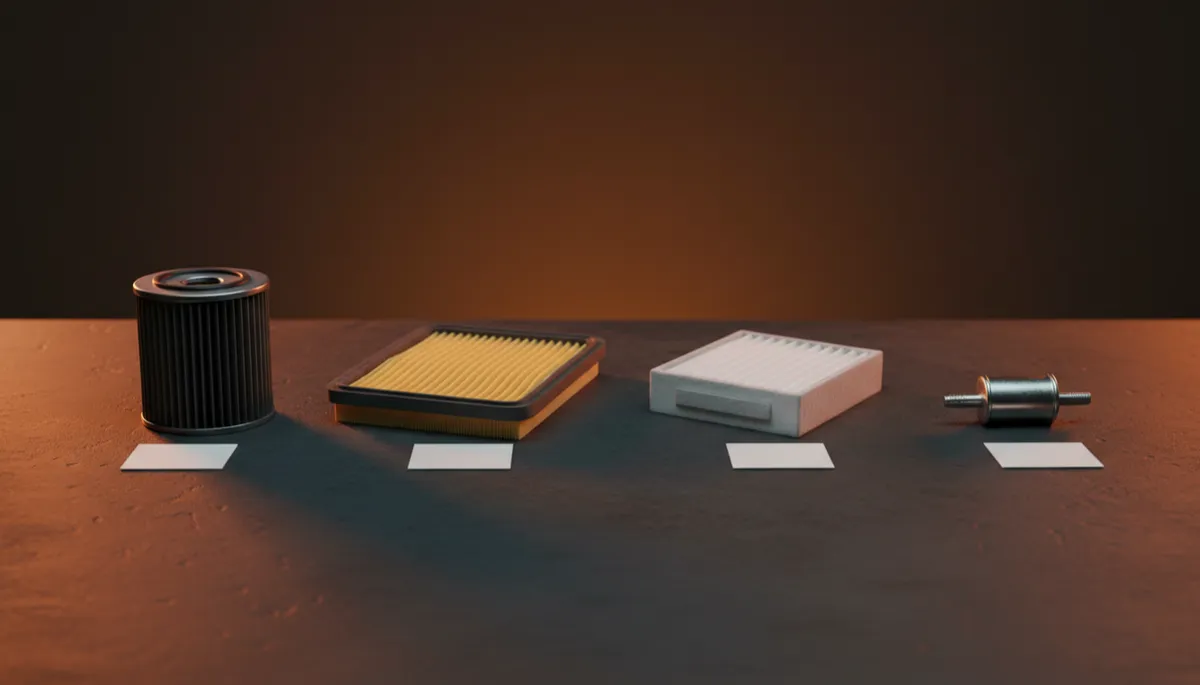
Oil Filter — The One That Goes with Every Oil Change
Your engine oil is constantly picking up tiny bits of metal, soot and sludge. The oil filter’s job is to trap these “damaging residues and deposits” so the oil that reaches the bearings and moving parts is as clean as possible (MANN-FILTER, mann-filter.com/za-en.html). Clean oil flows freely and protects the engine. Dirty oil carries abrasive particles that speed up wear and can shorten engine life over time.
In normal servicing, the oil filter is replaced at every oil change. It is the one filter that applies to almost every petrol and diesel vehicle on the road. Running new oil through an old, clogged filter — or keeping old oil with a new filter — defeats the whole point of the service. The oil and the filter work as a pair, so they should be changed together as a set, according to your service schedule in the owner’s manual.
Oil filters are engine-specific. The correct filter is chosen for that engine’s thread size, sealing surface, bypass valve setting and filtration rating. A filter that screws on and seems to fit is not always the right one. Using the wrong type can affect oil pressure, warm-up behaviour and how well contaminants are captured. When in doubt, check the part number on the old filter or use a trusted catalogue. The MANN-FILTER online catalogue accepts VIN and engine code searches to match filters to specific engines (mann-filter.com/en/catalog.html), which is how we confirm the right reference before supplying a part.
Engine Air Filter — Protecting What Your Engine Breathes
Just like you, your engine needs clean air to breathe. The engine air filter sits in the airbox and stops “soot, dust and contaminants” from reaching the combustion chamber, helping the engine deliver “optimum performance” (MANN-FILTER, mann-filter.com/za-en.html). Every litre of fuel burned needs many litres of air. If that air is full of grit, it can score cylinder walls, damage sensors and reduce efficiency over time.
Replacement intervals for air filters are vehicle-specific. Your owner’s manual will list when the filter should be checked or replaced. Many manufacturers also give separate guidance for “severe” or dusty conditions. In South Africa, with gravel roads, construction dust and frequent traffic, filters can load up faster than in cleaner environments. That is why checking the service schedule — and the actual condition of the filter — is important, rather than guessing based on mileage alone.
Engine air filters are shaped to fit a specific airbox. Some are flat panels, others are round or odd shapes. Before you order, confirm the correct reference for your exact engine, not just the model name. A filter that looks similar but does not seal correctly can let unfiltered air bypass the element. Also remember that a filter can be partly blocked without looking completely grey or black. Visual checks help, but they are not the only guide — follow the manual and your mechanic’s inspection. And never run the car without an air filter, even “just for a short test.” Unfiltered air goes straight into the engine and can cause damage surprisingly quickly.
Cabin Air Filter — Protecting What You Breathe
While the engine air filter protects the motor, the cabin air filter looks after you and your passengers. Also called a pollen filter or HVAC filter, it “extracts harmful particulates and allergens from intake air and circulates clean air within the vehicle.” Cabin filters with an activated carbon layer can also remove odours and noxious gases by up to 90% (MANN-FILTER, mann-filter.com/za-en.html). Without a cabin filter, outside air coming through the vents is essentially unfiltered, bringing dust, pollen and exhaust fumes straight into the cabin.
Not all vehicles have a replaceable cabin air filter. Some older or entry-level models were built without one, or the filter is not designed as a separate service item. The only reliable way to know is to check your owner’s manual or official service information for your specific car. Where a cabin filter is fitted, its replacement interval is usually on its own schedule, separate from the oil and engine air filters. It may be less frequent, but again, this is defined per vehicle, not the same for everyone.
A clogged cabin filter can reduce airflow from the vents, make the fan seem weak, and contribute to musty smells and extra dust inside the car. There are two main types. Standard particulate filters focus on dust and pollen. Combination filters add an activated carbon layer to help with gases and odours. If your vehicle can take the carbon type, it offers extra comfort, but it must be the exact reference designed for your car’s HVAC housing. Mixing and matching shapes or thicknesses is not recommended, as an incorrect fit can cause rattles or air bypass.
Fuel Filter — Protecting Your Injection System
Modern fuel systems work at high pressure with very fine injector tips. The fuel filter’s role is to “protect from dirt particles and water” and shield the “fuel injection system” from contamination (MANN-FILTER, mann-filter.com/za-en.html). Even small amounts of rust, dust or water in the fuel can affect spray patterns, cause misfires or, in severe cases, damage pumps and injectors, which are expensive parts to replace or repair.
It is important to know that not every vehicle has a separately serviceable fuel filter. Many newer cars and bakkies integrate the filter into the pump module inside the tank and do not call for a routine external filter change. Your owner’s manual will state whether there is a service item fuel filter and when it should be replaced. Do not assume there is always a canister or inline filter to change just because older cars had one under the bonnet or under the body.
Where a separate fuel filter is fitted, it is often on a longer cycle than the oil filter and may live in the engine bay, along the chassis rail or near the tank. Replacing it involves opening the fuel system, which carries fire and health risks. On many vehicles, this is best left to a qualified technician with the right tools and safety procedures. If you are ordering a fuel filter, confirm from the part number printed on the existing filter or use a catalogue that searches by VIN or engine code, such as the MANN-FILTER online catalogue, before you buy.
How to Know Which Filters Your Vehicle Actually Needs
With car filters explained, the big question is: how do you know what to order for your own vehicle? Here is a simple, practical checklist we use at Morris Garage in Pretoria when we help customers match parts to cars:
- Start with your owner’s manual. The service schedule is the most reliable guide. It lists which filters are replaceable items, under what conditions, and at what mileage or time. This is written for your exact model and engine, not a general rule of thumb.
- Check the part number on the old filter. When a filter comes off during a service, the number printed on it confirms what was fitted last time. This is a useful cross-check when ordering, especially on vehicles with mid-year changes or different engine options under the same badge.
- Use a parts catalogue. MANN-FILTER, for example, offers around 6,800 OE-quality filters covering over 300,000 applications and more than 85 years of experience (MANN-FILTER, mann-filter.com/za-en.html). Their online catalogue lets you enter a VIN, engine code or part number to see which filters match your vehicle (mann-filter.com/en/catalog.html).
- Ask your supplier. If you are still unsure, share your full vehicle details — make, model, year and engine code — with a trusted parts supplier. We do this every day at Morris Garage to confirm compatibility before we quote. It is better to double-check than to arrive at service time with the wrong spares.
The key point is that filter replacement is vehicle-specific, not universal. There is no standard “four-filter service” that automatically applies to every car, SUV or bakkie. Your car might have all four as separate items, some of them, or certain filters on different cycles. Let the manual and correct part references guide you.
OEM Quality and Aftermarket Filters — A Brief Note
When you look at replacement filters, you will see different brands and price levels. Manufacturers like MANN-FILTER supply OE-quality and aftermarket filters — parts built to the same standard as original equipment but sold through the independent parts market. Genuine filters in the car maker’s box are available from authorised dealers and carry the vehicle manufacturer’s own branding and warranty channel. Quality branded aftermarket filters are the normal choice for routine servicing at independent workshops in South Africa, including here at Morris Garage. We also work with other reputable brands, depending on availability and your budget.
The most important thing is that the filter is the correct reference for your specific engine and that it meets a recognised quality standard. A cheap, unbranded filter with no clear specification can cost you far more in the long run if it fails or does not filter properly. Always balance price with quality, and never compromise on correct fitment just to save a few rand on a service item.
FAQs
Q1: Can I skip a filter replacement to save money?
It depends on the filter and whether it is due. Skipping an oil filter when you change the oil defeats the point of fresh oil, because old contaminants stay in the system. Skipping a cabin filter mainly affects air quality and HVAC performance, not immediate mechanical safety, but it can make the car less pleasant to live with. Engine air and fuel filters are there to protect the engine and injection system; delaying them beyond the schedule increases wear risk over time. Follow the service intervals for each filter separately in your manual.
Q2: My car smells musty from the vents — is it the cabin filter?
A clogged or overdue cabin filter can definitely contribute to musty or dusty smells from the vents, especially if it has trapped moisture and dirt. It is one possible cause, and replacing it when due is a sensible first step. However, smells can also come from moisture on the evaporator or other HVAC issues. If odours continue after fitting a fresh, correct cabin filter, ask a workshop to inspect the ventilation system properly.
Q3: Does the type of filter brand matter, or is any filter the same?
The correct part number for your car comes first. Once that is confirmed, brand and quality level do matter. A recognised OEM or branded aftermarket filter is built to meet the same specifications as the original. Very cheap, unbranded filters often use lower-grade materials and may not filter as well or last as long. If you are unsure, ask your supplier which brand they are offering and why. At Morris Garage, we are always happy to explain the options and help you choose a filter that suits your car and your pocket.
Q4: How do I find the right filter without the part number?
If you do not have the old filter in front of you, do not stress. Send us your vehicle’s make, model, year and engine code. We use tools like the MANN-FILTER online catalogue, which accepts VIN and engine code searches, to look up the correct filter references for your specific vehicle. That way we can confirm compatibility before we quote, so you do not waste time or money on the wrong parts.
Need Filters for Your Vehicle?
Honest service. Quality spares. Fair prices. If you need oil, air, cabin or fuel filters for your BMW, Mercedes-Benz, Audi, Volkswagen, Chery, Haval or GWM, we are ready to help from our shop in Pretoria East. Tell us what work you are planning and we will help you match the right filters to your vehicle and service schedule — no overselling, no guesswork, just the parts you actually need.
Need help finding the right part? Send Morris Garage your vehicle make, model, year and the part you need. Add the engine details, part number or a photo if available, and request a compatibility, availability and price check.
Chat with us on WhatsApp and we will gladly assist you with filter options, pricing and availability before you book your service or start a repair at home or in your workshop.
Morris Garage / Spares Boys Pretoria · 199 Stormvoel Road, Eastlyne, Pretoria, Gauteng
An enquiry does not reserve stock or confirm compatibility.