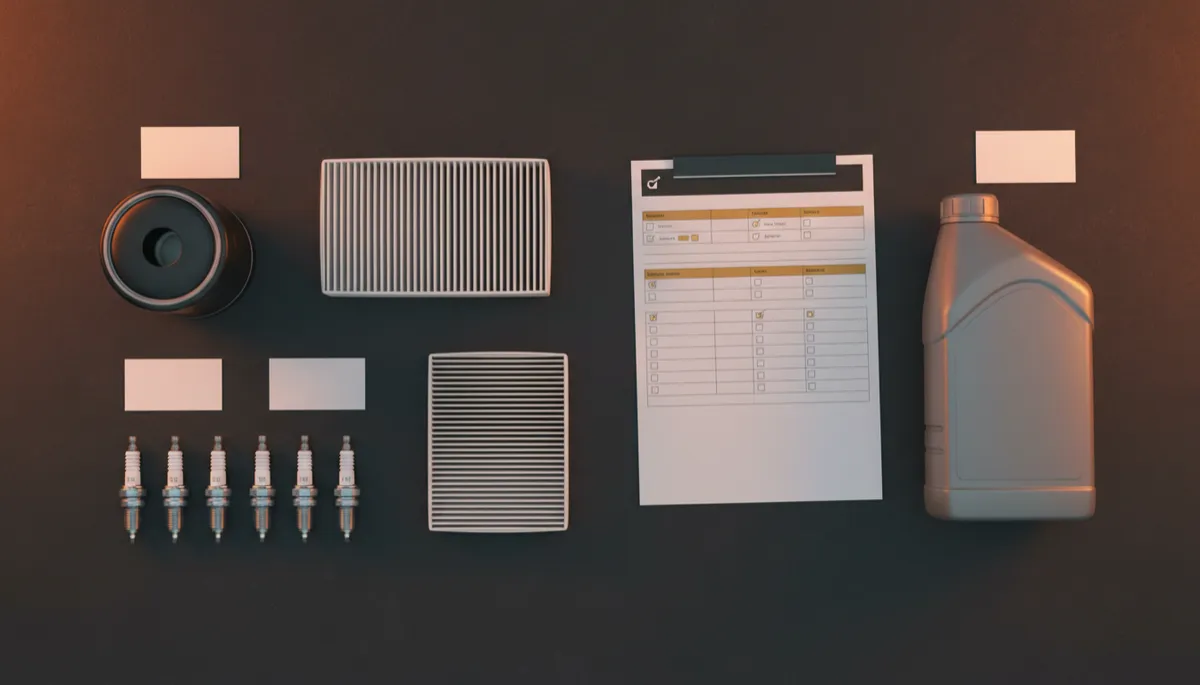
Essential Car Service Kit: What to Check Before Buying
Car Spares, Car Service Kit, Vehicle Maintenance
What Should Be in a Car Service Kit? Check Before Buying a Bundle
You spot a car service kit online or at a spares counter. It looks perfect – filters, spark plugs, maybe a sump plug washer. You buy it, book the service, and only then discover there is no oil, the kit has the wrong number of spark plugs, and the cabin filter is only due next year. A service kit only saves you time and money if it actually matches your engine, your current service interval and the right quantities. These seven checks prevent a wasted order.

1. Does the Kit Match Your Engine — Not Just Your Model?
Many service bundles are listed by model name only – something like “Golf 1.4” or “C-Class 2.0”. That sounds clear, but it is not specific enough. Over the years manufacturers have sold many different engines under the same model and badge. A 1.4-litre engine from one generation can use completely different filters to a 1.4 from another generation, even though the badge on the boot looks the same to you and me.
A filter that fits one engine will not necessarily fit another, even in the same model. Before you confirm any car service kit, make sure the individual filter references in the kit are correct for your specific engine code and year, not just the model name on the advert or box. You can:
- Check the part numbers on your existing oil, air, fuel or cabin filters and compare them to the kit list, or
- Use the MANN-FILTER online catalogue (mann-filter.com/en/catalog.html). It accepts your VIN or engine code and returns the correct filter references from a range that covers over 300,000 applications in OE quality and aftermarket versions.
At Morris Garage in Pretoria, we work from your engine details, not just the badge. That is how you avoid the “almost right” kit that leaves you stuck mid-service.
2. What Does Your Service Schedule Actually Require at This Interval?
Not every part is replaced at every service. Your owner’s manual sets out a schedule – which items are checked or replaced at each mileage or time interval. Oil and oil filter are usually done most often. Other parts, like cabin filters and spark plugs, are usually on longer cycles. A kit that includes everything under the sun might look impressive, but if half of those parts are only due at another interval, your money is tied up in spares that sit on a shelf gathering dust.
The opposite problem is just as common. You buy a kit, only to realise on service day that it does not include something that is due now according to your schedule. Then you are scrambling for extra parts at the last minute, or delaying the job. Before you buy any car service kit, grab your owner’s manual, find the page for your current interval and write down exactly what is due. Then compare that list item by item with the kit contents. If the two lists do not line up, rather adjust the kit or build your own combination of parts.
3. How Many Spark Plugs Does Your Engine Need?
Spark plugs are where quantity mistakes show up most often. The basic rule is simple: a four-cylinder engine uses four spark plugs, a six-cylinder uses six, and a V8 uses eight. Yet many kits are advertised as “a set of spark plugs” without clearly stating how many plugs are actually in the box. If your engine is a six-cylinder and the kit quietly includes only four plugs, you are two short and your service stops right there.
Plug type also matters. Copper, iridium, double platinum and other electrode designs are not simply interchangeable. Your owner’s manual, or the markings on your existing plugs, tell you which type and specification your engine was designed for. When you look at a car service kit, ask:
- Exactly how many spark plugs are included in this kit?
- What type and specification are they, and do they match what your engine calls for?
If the seller cannot answer those questions clearly, rather treat the plug part of the bundle with caution and match them by reference instead of by guesswork.
4. Is Engine Oil Included — and Is It the Right Grade and Quantity?
Many service kits are really “filter and small-parts” kits. They do not include engine oil at all. If you assume oil is included and only discover it is not when the car is already on the lift, you lose time and your mechanic loses patience. Always check the description: is oil actually part of this bundle, or must it be bought separately?
Where oil is included, do not just see a brand name and feel safe. Confirm three things against your owner’s manual: the grade (viscosity rating), the specification or approval, and the quantity in litres. An engine that requires more oil than the kit provides will not be properly filled. Never change to a different grade just because “that is what comes in the kit”. Your manual is the final word. If the kit oil does not match, use the kit for its filters and plugs, and source the correct oil separately.
5. What Is the Kit Missing? Check the Exclusions
“Complete service kit” usually means complete for the items listed on the box – not complete for everything your car needs at that service. Most standard kits do not include:
- Engine oil (very commonly excluded)
- Coolant or any other top-up fluids
- Brake fluid for scheduled changes or bleeding
- Wiper blades or washer fluid
- Drain plug crush washer – sometimes included, sometimes not, so always confirm
- Timing belt or cambelt kits, tensioners and water pumps, which are normally separate major jobs
Read the contents line by line and compare them with what your service schedule lists. Anything not covered by the kit can be added separately so that you arrive at the workshop fully equipped, without surprises or extra trips to the parts store.
6. Are Genuine, OEM or Aftermarket Parts Clearly Stated?
Service kits can be built from different quality levels. Some bundles use genuine or OEM-equivalent brands, others use unbranded components. Before you decide based on price alone, ask which brands are supplying the filters, spark plugs and other parts in the kit, and whether they are recognised OEM or aftermarket names. For filters, for example, the MANN-FILTER range is produced in OE quality for the automotive aftermarket, which gives you confidence that the parts meet the original standards (mann-filter.com/za-en.html).
If your goal is a genuine Volkswagen, BMW, Mercedes-Benz, Audi, Chery, Haval or GWM service, a kit built from generic parts will not deliver that. For genuine VW parts information, you can consult an authorised dealer or vw.co.za, and then work with a trusted supplier to match those references. The key is transparency – you should always know what quality level you are paying for.
7. Is This the Correct Kit for Your Service Interval — Minor or Major?
Many manufacturers distinguish between minor and major services. A minor service might focus on oil, filter and basic checks, while a major service adds more items. Some suppliers sell separate kits for each type of service. If you use a minor-service kit on a major-service interval, you will not cover everything that is due. If you use a major-service kit on a minor interval, you pay for parts you do not actually need yet.
Check your owner’s manual to see whether this visit is minor or major, and then confirm that the kit you are looking at clearly states which interval it is meant for. If it is not obvious, ask the supplier to explain how the contents line up with your schedule before you place the order.
Your Service Kit Verification Checklist — At a Glance
- Filter references confirmed for your engine code and year, not just the model name.
- Kit contents checked against your owner’s manual for this specific service interval.
- Spark plug count matches your cylinder count; plug type and specification confirmed.
- Oil clearly marked as included or excluded; if included, grade, approval and litres match your engine’s requirement.
- Common exclusions identified and sourced separately – oil (if needed), drain plug washer, coolant, brake fluid, wiper blades and any belt kits due.
- Parts quality and brand confirmed – genuine, OEM or branded aftermarket, not mystery components.
- Minor vs major service checked, and the kit matched to the correct interval for your vehicle.
A good car service kit is a time-saver, not a shortcut past the details. Spending a few minutes on these seven checks protects your budget, your engine and your workshop schedule from nasty surprises.
FAQs
Q1: Can I build my own service kit instead of buying a bundle?
Yes, you can. Ordering each item separately gives you full control over the reference, brand, quantity and quality. It does take a bit more preparation – you need your engine code or the part numbers from your existing components – but you remove the risk of a bundle including wrong or unneeded items. At Morris Garage, we can help you build a correct list from your vehicle and engine details so you only buy what you actually need for this service.
Q2: My service kit arrived but one filter does not fit — what went wrong?
The most common reason is that the kit was assembled for the model name, not your exact engine variant. Start by checking the part number on the filter that does not fit against the number on your existing filter. If they differ, the wrong reference was supplied. Contact the supplier with your engine code and the part number from the old filter so they can match the correct replacement and swap out the incorrect item where possible.
Q3: Is it worth buying a more expensive “OEM” service kit versus a standard aftermarket one?
The correct reference is more important than the marketing label. A quality aftermarket car service kit with the right filter numbers and a known brand is a solid choice for most routine services. If your vehicle is still under warranty, or if you specifically want genuine manufacturer-branded parts, confirm the parts channel before you pay. Different sellers use “OEM” in different ways, so always ask whether the kit is genuine manufacturer stock or simply good aftermarket components.
Q4: My owner’s manual calls for a specific oil specification I cannot find in the kit — can I use a different grade?
We do not recommend it. Oil viscosity and approval codes are chosen by the engine designer for a reason. Using the wrong grade or specification can affect protection, fuel economy and long-term reliability. If the kit oil does not match what your manual asks for, rather buy the correct oil separately and use the kit for the filters and plugs only. That way you keep both your engine and your service record in good shape.
Need the Right Parts for Your Service?
Need help finding the right part? Send Morris Garage your vehicle make, model, year and the part you need. Add the engine details, part number or a photo if available, and request a compatibility, availability and price check.
Chat with us on WhatsApp and we will help you match the right spares to your BMW, Mercedes-Benz, Audi, Volkswagen, Chery, Haval or GWM – whether you are a car owner, independent mechanic, workshop or panel beater in Gauteng and beyond.
Morris Garage / Spares Boys Pretoria · 199 Stormvoel Road, Eastlyne, Pretoria, Gauteng
An enquiry does not reserve stock or confirm compatibility.
Sources and Further Reading
- MANN-FILTER South Africa — OE quality and aftermarket filters for over 300,000 applications: www.mann-filter.com/za-en.html
- MANN-FILTER Online Catalogue — VIN and engine code search for correct filter references: www.mann-filter.com/en/catalog.html
- Volkswagen South Africa — Genuine Parts information: www.vw.co.za
- Your vehicle’s owner’s manual — the definitive source for service schedules, oil specifications and replacement intervals.